2. Architecture
State
The layering is settled. The node runtime and placement path are Partial (one node, compose bundle). The node contract is Draft.
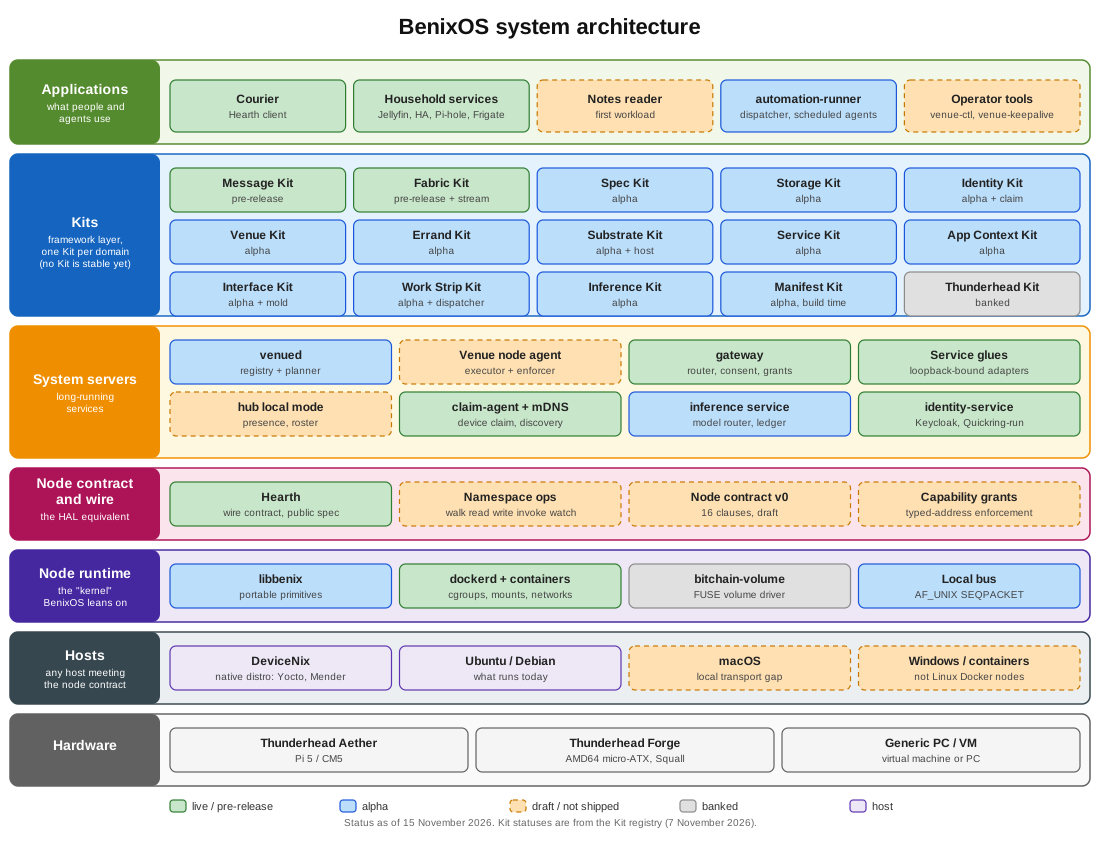
The layers
| Layer | What lives here | Chapter |
|---|---|---|
| Applications | Courier, household services (Jellyfin, Home Assistant, Pi-hole, Frigate), automation, operator tools | 12 |
| Kits | The framework layer: one Kit per domain | 4 |
| System servers | venued, the node agent, the gateway, glues, claim and discovery |
5, 6, 8 |
| Node contract and wire | Hearth, namespace ops, the node contract, capability grants | 3, 7 |
| Node runtime | libbenix, dockerd and containers, local bus | 11 |
| Hosts | DeviceNix, Ubuntu/Debian, macOS, Windows | 11 |
| Hardware | Thunderhead Aether (Pi 5 / CM5), Forge (AMD64) | 11 |
The Android comparison is useful for the shape and misleading in two places. Hosts are plural: there is no single kernel at the bottom, only "any host that meets the node contract". And placement has no Android counterpart: deciding which node runs a workload, and having that node independently decide whether to, is the distributed part.
Three planes
The design separates three jobs that are easy to blur.
| Plane | Job | Owner |
|---|---|---|
| Control | Decide where work may run: registry, planner, leases | Venue (venued) |
| Enforcement | Decide whether it runs, from owner-signed grants and local policy | The node agent (the executor) |
| Wire | Carry messages between nodes, with identity, sealing and ordering | Hearth, via Message Kit and Fabric Kit |
The central rule
A placement is not an authorization. Venue decides where; the node agent independently decides whether. A placement with no covering grant is refused. (Node contract §5.1.)
This is why the node agent is a separate process from the registry, and why the registry holds no Docker socket. A compromised registry can ask for bad work; it cannot make a node do it.
Who trusts whom
flowchart LR
  OWNER["Owner<br/>device-root key"]
  REG["Registry<br/>(venued)"]
  NODE["Node agent"]
  WORK["Workload"]
  HUB["Hub<br/>(untrusted for content)"]

  OWNER -- "signs grants, pins registry key at claim" --> NODE
  OWNER -- "signs admissions" --> NODE
  REG -- "signed placement: where" --> NODE
  NODE -- "starts only what grants + local policy allow" --> WORK
  HUB -. "carries sealed frames; cannot read or forge" .- NODE
- The owner is the person whose key was pinned on the node at claim. Their key is the root of every offline check.
- The registry is trusted for placement order, not for authorization.
- The hub carries sealed payloads. The seal proves only "some household device", so the registry's signature goes inside the sealed payload (contract §9.3).
- Keycloak authenticates a human to the consent step. It is never an input to a node's grant check (contract §2.3).
Where the code lives
| Area | Repo | Org |
|---|---|---|
| Wire spec | hearth |
slash-builder |
| Kits (one repo each, except merged ones) | message-kit, fabric-kit, venue-kit, storage-kit, … |
slash-builder |
| System tree (new) | benixos (executor, compose bundle) |
benixos org |
| Distribution prototype | distribution |
benixos |
| Host distro | core (Yocto, meta-benixos) |
slash-builder |
| Gateway and glue | gateway, service-catalog |
slash-builder, private |
| Commercial operator | hub, api, courier, identity-service |
quickring |
New system code goes in one monorepo, and existing system repos do not migrate yet. First-tier BenixOS repos live in the benixos GitHub organisation. Kits stay in slash-builder.
Topology
The working design for several nodes is a star: one registry host, an executor on every node, nodes connect outbound only, mutual TLS on the one inbound port. It is built and reviewed only against a simulated cluster so far (chapter 6).